

An e-mountain bike is defined as a mountain bike fitted with an integrated electric motor and rechargeable battery that provides pedal assistance for off-road riding. The industry term is e-MTB, and it covers every bike built around the same core idea: you pedal, the motor amplifies your effort, and you ride farther and climb harder than you could on a traditional mountain bike. This guide covers how e-MTBs work, what makes them different, and how to pick the right one for your trails.
The motor on an e-MTB does not replace your pedaling. It multiplies it. When you push the pedals, sensors detect your input and the motor adds power on top. Stop pedaling, and the assist stops too. That is the pedal-assist principle, and it is what separates an e-MTB from a motorcycle or a scooter.
Most e-MTBs use mid-drive motor systems where the motor sits near the bottom bracket and drives the chain directly. This placement keeps weight centered and low, which improves handling on technical terrain. Hub motors, mounted in the wheel, are simpler and cheaper but sacrifice that weight balance.
Under the U.S. Class 1 framework, motor assistance cuts off at 20 mph and there is no throttle. This classification matters because it determines where you can legally ride. Many national forests and trail systems that ban throttle e-bikes allow Class 1 e-MTBs without restriction.
Batteries are almost universally lithium-ion, and some models support range extenders to push ride distance further. A handlebar-mounted display lets you switch between power modes, typically Eco, Trail, Boost, and Turbo, so you control how aggressively the motor assists at any moment.
Key system components at a glance:
Pro Tip: Mid-drive motors multiply torque through your bike’s gears. Shift to a lower gear on steep climbs to let the motor work efficiently and preserve battery life.
An e-MTB looks like a mountain bike because it is one. It runs the same knobby tires, the same suspension forks, and the same dropper posts you find on any trail bike. The differences are in what you cannot see at first glance.
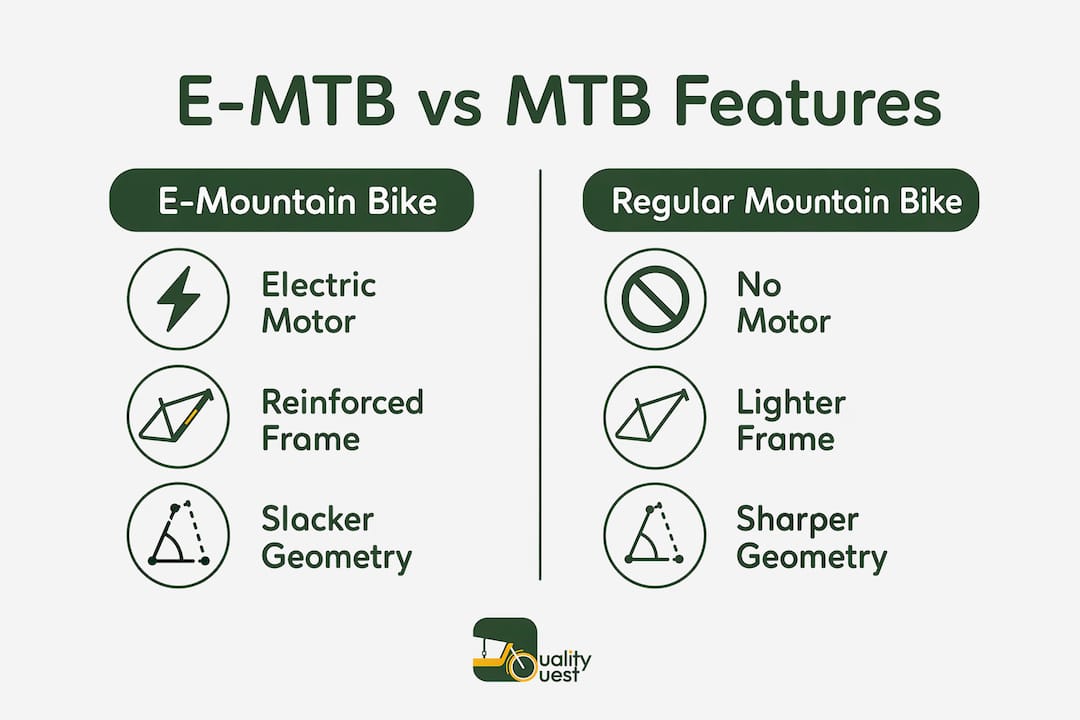
The frame is reinforced to handle the extra weight and torque the motor generates. A typical trail mountain bike weighs 26 to 30 pounds. An e-MTB with motor and battery typically weighs 45 to 55 pounds. That weight changes how the bike handles at low speeds and makes portability a real consideration for riders who load bikes onto cars or carry them up stairs.
Geometry on e-MTBs is often slacker and longer than equivalent non-electric models. Designers account for the fact that riders will be moving faster uphill and need more stability on descents. Suspension travel tends to be generous, with 140 to 160mm common on trail-focused e-MTBs, because electric assist extends riding capability into terrain that would exhaust most riders on a traditional bike.
The drivetrain is typically a 1x system (single chainring up front) with a wide-range cassette in the rear. Some premium models use belt drives for lower maintenance, though chains remain the standard. Battery integration has improved significantly. Most current e-MTBs house the battery inside the downtube, which protects it from trail debris and keeps the profile clean.
The biggest benefit is access. Riders who struggle with steep climbs, riders returning from injury, and riders who simply want to cover more trail in a single session all gain something real from pedal assist. Electric assist extends rides without removing the physical effort of pedaling, so fitness still matters and the experience still feels like mountain biking.
Class 1 e-MTBs also benefit from wider trail access compared to throttle or higher-speed e-bikes. Trail communities and land managers are more receptive to pedal-assist bikes that behave like traditional mountain bikes at speed. That acceptance is growing, not shrinking.
The drawbacks are real too:
Pro Tip: Motor assist behavior is most natural around 80 to 90 RPM pedaling cadence. Maintain a smooth, consistent pedal stroke rather than grinding in a big gear to get the best feel and efficiency from your motor.
Start with where you ride. Tight, technical singletrack demands a shorter, more nimble bike with a mid-drive motor and good suspension. Long fire road climbs and endurance rides favor a larger battery and a more relaxed geometry. These two use cases point toward different bikes.
The two broad categories in the market are Full-Power e-MTBs and Lightweight (or “light e-MTB”) models. Full-Power bikes carry motors in the 250W to 750W range with batteries above 500Wh. Lightweight models use smaller motors and batteries to stay under 40 pounds, trading range for handling feel closer to a traditional bike.
Factors to evaluate before you buy:
Range is influenced by riding style and terrain far more than battery size alone. A 500Wh battery on a flat trail in Eco mode will outlast the same battery on a steep climb in Turbo mode by a factor of three or more. Plan your rides around power mode strategy, not just the battery percentage shown on your display.
An e-mountain bike is a pedal-assist off-road bicycle that amplifies rider effort through a mid-drive motor and lithium-ion battery, giving you access to more terrain without replacing the physical experience of mountain biking.

An e-mountain bike is not a replacement for mountain biking—it simply helps riders go farther, climb easier, and spend more time exploring. Because the motor only provides assistance while you pedal, the riding experience remains active and engaging while reducing fatigue on long climbs and challenging terrain.
For hunters, campers, and backcountry adventurers, e-MTBs offer a practical way to access remote areas quietly and efficiently without relying on a vehicle. They are equally valuable for recreational riders looking to cover more trail mileage in a single outing.
The most capable e-MTBs use mid-drive motors for better balance, climbing power, and natural handling. While their additional weight requires some adjustment, riders benefit from increased range and capability across a wider variety of terrain.
When choosing an e-MTB, remember that range depends heavily on terrain and riding style, and trail access often depends on classification. Class 1 pedal-assist models generally provide the broadest trail access and are the preferred option for riders who want to stay compliant while maximizing where they can ride.
Whether you're trail riding, scouting hunting grounds, reaching remote campsites, or exploring new terrain, an e-MTB can expand your range without taking away the adventure.
— Matt
Ready to put what you have learned into practice? Quality Quest Bikes carries a curated selection of electric bikes built for riders who want real off-road performance without the guesswork.
Check our Off-road Ebike Collection:

An e-MTB adds an integrated electric motor and battery that provides pedal assistance, making climbs easier and extending ride distance. The core riding experience, including pedaling, steering, and suspension, stays the same as a traditional mountain bike.
Range varies based on terrain, rider weight, and power mode, with most e-MTBs covering 20 to 60 miles per charge. Steep climbs in high-assist modes drain the battery significantly faster than flat trails in Eco mode.
Class 1 pedal-assist e-MTBs are permitted on many trails that allow traditional mountain bikes, but regulations vary by land manager and region. Always check local trail rules before riding, as throttle or higher-speed e-bikes face stricter restrictions.
Yes. Pedal assist amplifies your effort but does not replace it. You still pedal the entire ride, and studies confirm that e-MTB riders get meaningful cardiovascular exercise, especially on longer or more technical routes.
Mid-drive motors are the preferred choice for off-road riding because they sit near the bottom bracket, keeping weight centered and allowing torque multiplication through the bike’s gears on steep climbs.



You deserve quality products at fair prices. Period.
Which is why we offer no sales tax and price matching
Orders include free shipping and are dispatched within 1 -2 business days.
Exceptions apply.

We want you to be enthusiastically satisfied with your order, have any questions?
Your support keeps our wheels rolling!
We’re more than just a store — we’re part of a growing local community of utility bike and trike enthusiasts who are passionate about creating positive change.
Subscribe and be the first to learn about our news and promotions

Your cart is empty